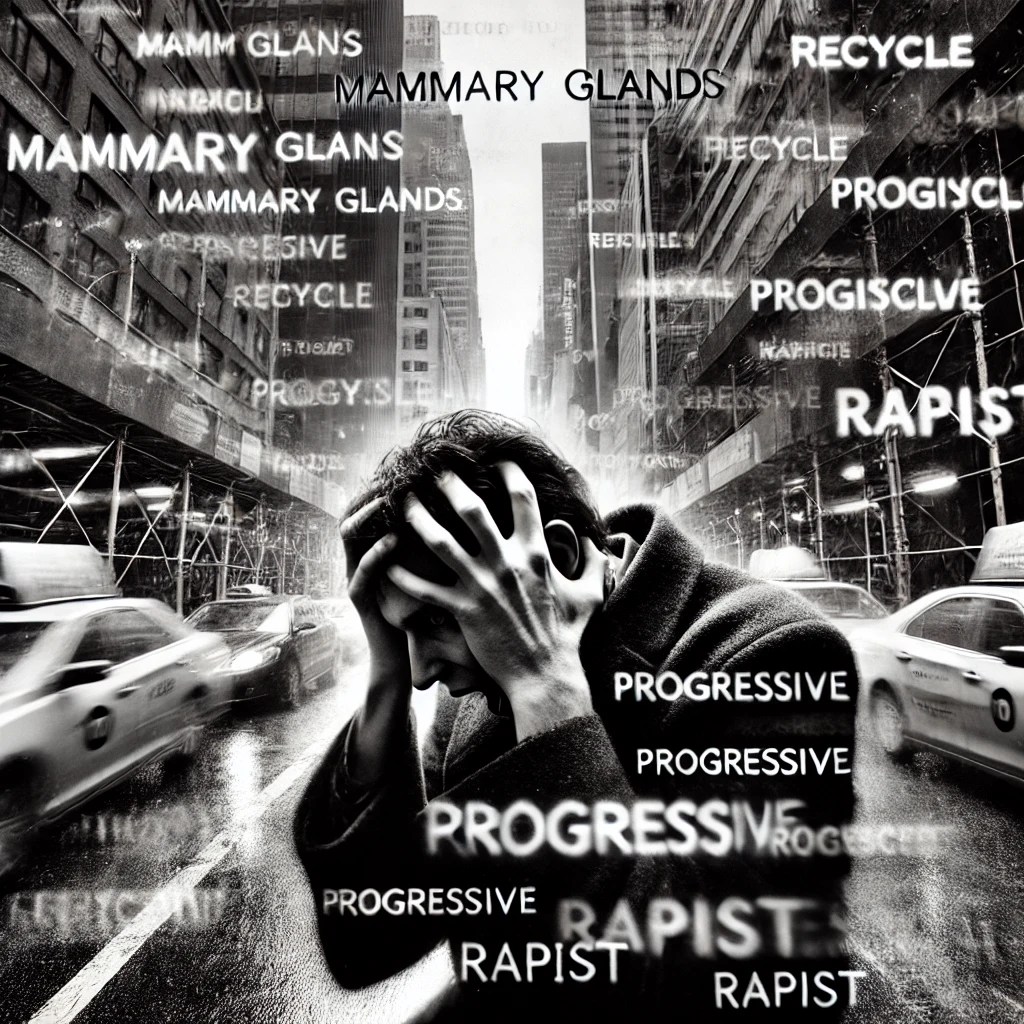
Image Copyright The Brussels Review
I am very proud to announce that my story “Recycling” has been published in The Brussels Review. “Recycling” is a satire which takes aim at the American ideological Left.
I have been thinking for some time about how the Left has been gradually sublimating the whole of the Christian paradigm, complete with moral absolutism, judgmentalism and guilt, and how this can cause all the same repression, and hence the same dangers to the individual, as traditional religion.
The idea for the character in “Recycling” came while I was reading Julien Green’s Each Man His Darkness, published in 1960. The novel deals with a young man torn between his natural sexual desires and his Catholic faith, and I couldn’t help but think that a young person, today, could find themselves in a similar position, but with politics playing a similar role as religious belief. As I started to envision this troubled character, and thinking about sources of secular guilt, I also thought about how, whenever I am unsure if I have made the prefect decision in any and all environmental matters, such as recycling (which I do obsessively), I can feel an anxiety triggering guilt, and even fear, as if the Earth might somehow punish me. Once I put these two potential sources of neuroses together, I had my main character, and the story went from there.
Once I was happy with “Recycling” I began sending it off to American literary magazines. Though I began optimistically (how else does one begin anything in the arts?) after dozens of rejections I realized I was being foolish. American literary magazines are, after all, nearly exclusively run by the ideological Left, which tends to have very little sense of humor about itself, and would almost certainly never publish something that dared to challenge their ethos. It then occurred to me what an extraordinary power structure we have built around the arts, a moral power structure that strictly regulates what gets read, seen, or heard. I believe one would have to look back to the 16th century, when the Catholic Church was in its heyday, to find a time when the arts were as heavily censored by a moral power.
But I also remembered that, more recently, authors deemed morally unacceptable in the United States, such as James Joyce, William S. Burroughs, and Henry Miller, just to name a few, found a more open atmosphere in Europe. It was just about this time that The Brussels Review came to my attention. As well as being a beautifully produced online journal, something on their About Page immediately caught my attention: We have a simple rule here at TBR: there are no forbidden words, subjects, or any form of censorship. We welcome all ideas and opinions, as long as they hold literary value. We believe in the freedom of expression and the importance of open dialogue in literature. Well, I thought, if they mean what I think they mean, this could be the journal for me. And sure enough, shortly after I sent it to them they enthusiastically accepted it for publication.
As happy as I am to finally publish this story, I am still depressed about the condition of the arts in the United States. When it bows to an ethos, Art becomes inevitably dogmatic, banal and conformist; one can only hope that, following the example of Europe, the United States will eventually evolve beyond its fundamentalist zeal. In the meantime, I believe it is imperative that artists start challenging the restrictions imposed by the ideological Left- not, of course, from a conservative point of view, but in the spirit of unlimited freedom, the kind of freedom without which art suffocates and dies.
 William Hugel