I am honored to announce that “Broadside For Already Sinking Ships,” a work of lyrical philosophy, has been published by EgoPhobia, a Romanian journal of literature and philosophy.
“Broadside For Already Sinking Ships” is a sort of philosophy/literature hybrid, written in the Russian Slavophile spirit. It aims to attack all rational dogmas, and the very essence of Western certainty, including the obsession with political identities, in favor of an “apotheosis through groundless,” as Lev Shestov wonderfully put it. The thinking of Western, educated people has become dogmatic, radically conformist, and hence ossified. This work aims to smash it. Call it philosophizing with a hammer.
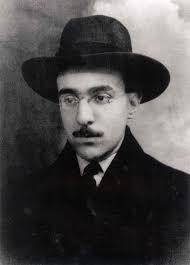
This is from Fernando Pessoa’s The Book Of Disquiet.
Absolutely brilliant.
“We generally colour our ideas of the unknown with the known… With slight misconceptions of reality we fabricate our hopes and beliefs, and we live off crusts that we call cakes, like poor children who make believe they’re happy.
But that’s how all life is, or at least that particular system of life generally known as civilization. Civilization consists in giving something a name that doesn’t belong to it and then dreaming over the result.”
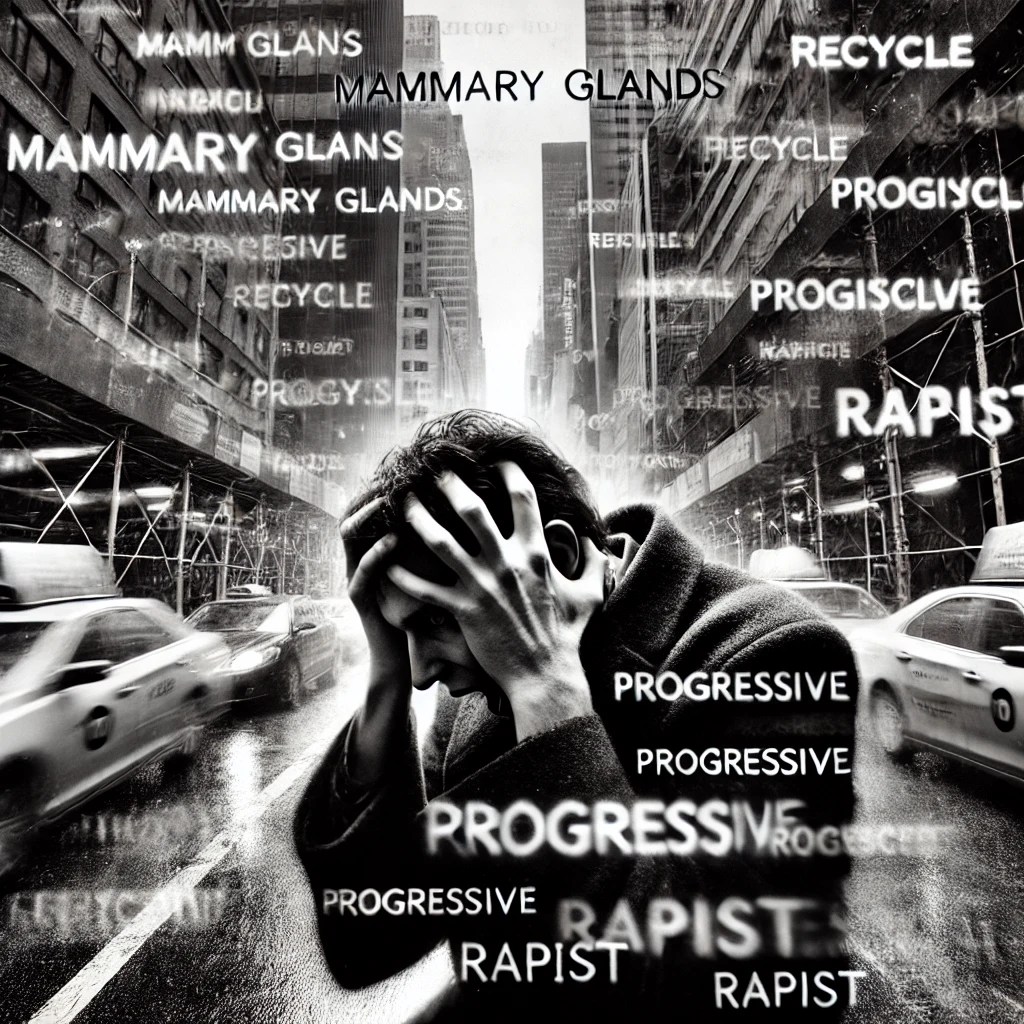
I am very proud to announce that my story “Recycling” has been published in The Brussels Review. “Recycling” is a satire which takes aim at the American ideological Left.
I have been thinking for some time about how the Left has been gradually sublimating the whole of the Christian paradigm, complete with moral absolutism, judgmentalism and guilt, and how this can cause all the same repression, and hence the same dangers to the individual, as traditional religion.
The idea for the character in “Recycling” came while I was reading Julien Green’s Each Man His Darkness, published in 1960. The novel deals with a young man torn between his natural sexual desires and his Catholic faith, and I couldn’t help but think that a young person, today, could find themselves in a similar position, but with politics playing a similar role as religious belief. As I started to envision this troubled character, and thinking about sources of secular guilt, I also thought about how, whenever I am unsure if I have made the prefect decision in any and all environmental matters, such as recycling (which I do obsessively), I can feel an anxiety triggering guilt, and even fear, as if the Earth might somehow punish me. Once I put these two potential sources of neuroses together, I had my main character, and the story went from there.
Once I was happy with “Recycling” I began sending it off to American literary magazines. Though I began optimistically (how else does one begin anything in the arts?) after dozens of rejections I realized I was being foolish. American literary magazines are, after all, nearly exclusively run by the ideological Left, which tends to have very little sense of humor about itself, and would almost certainly never publish something that dared to challenge their ethos. It then occurred to me what an extraordinary power structure we have built around the arts, a moral power structure that strictly regulates what gets read, seen, or heard. I believe one would have to look back to the 16th century, when the Catholic Church was in its heyday, to find a time when the arts were as heavily censored by a moral power.
But I also remembered that, more recently, authors deemed morally unacceptable in the United States, such as James Joyce, William S. Burroughs, and Henry Miller, just to name a few, found a more open atmosphere in Europe. It was just about this time that The Brussels Review came to my attention. As well as being a beautifully produced online journal, something on their About Page immediately caught my attention: We have a simple rule here at TBR: there are no forbidden words, subjects, or any form of censorship. We welcome all ideas and opinions, as long as they hold literary value. We believe in the freedom of expression and the importance of open dialogue in literature. Well, I thought, if they mean what I think they mean, this could be the journal for me. And sure enough, shortly after I sent it to them they enthusiastically accepted it for publication.
As happy as I am to finally publish this story, I am still depressed about the condition of the arts in the United States. When it bows to an ethos, Art becomes inevitably dogmatic, banal and conformist; one can only hope that, following the example of Europe, the United States will eventually evolve beyond its fundamentalist zeal. In the meantime, I believe it is imperative that artists start challenging the restrictions imposed by the ideological Left- not, of course, from a conservative point of view, but in the spirit of unlimited freedom, the kind of freedom without which art suffocates and dies.
I was fortunate enough to spend some time in Lisbon recently, and while I was there I came upon a statue of Fernando Pessoa. Reading about him I discovered that he is considered Portugal’s greatest writer from the Modern Period. I have since been reading The Book of Disquiet. It is unlike anything I’ve read before, and truly extraordinary. Here’s an excerpt:
“Not pleasure, not glory, not power… Freedom, only freedom.
To go from the phantoms of faith to the ghosts of reason is merely to change cells. Art, if it frees us from the abstract idols of old, should also free us from the magnanimous ideas and social concerns, which are likewise idols.
To find our personality by losing it- faith itself endorses this destiny.”
I am very excited to announce that my first work of what I am calling “lyrical philosophy” has been published in PSA, the peer-reviewed journal of The Pirandello Society of America. The piece discusses how there appears to be a profound discord between life and the way we think about it, tracing the source of this split back to the philosophers of Ancient Greece. It explores how this disassociation from reality was an inevitable product of rationalism, and envisions an irrationalist future of infinite freedom.
I have been discovering some outstanding African writers lately, mostly from Algeria, Senegal and Nigeria.
This is from Algerian writer Boualem Sansal’s “The Voice,” which describes the sensation when one’s false sense of certainty is shattered.
“Ancient groans worn out by the steady hum of the days explode in infernal dungeons and belch into our mouths like volcanic lava. The collapse occurs when everything seems fine, when tomorrow looks like being the perfect replica of the day before. But good God, what do we know of the soul’s cries, of the fractures of our being, of the silent miseries that poison our legs? Where the mind never ventures for want of light and walkways and a safety harness tight enough to cope with death rattles, the smell of putrefaction and viscous couplings, in those depths there arise colossal ruptures, infinite dramas, final ends…”
I’m reading an extraordinary essay by Wesley J. Wildman, “The Quest For Harmony.” I think he gets to the heart of the problem of the worldwide dominance of Western culture.
Some excerpts:
“Modernity, however, has proved to be both boon and bane. These transformations are so powerful and pervasive that it is scarcely possible to escape their influence, no matter where in the world one lives; the modern West seems to sweep all before it, or under it, capturing or breaking the imagination of many people in other cultures, and transforming life for better or worse. To many non-Western cultures less geared to expansion and consumption, this is a matter of great concern, for they find themselves changing rapidly under the influence of the West, but with little internal capacity to assess, assimilate, or resist what is happening.”
“…widespread overreliance on our analytical and controlling expertise, to the point that our feeling for nature, for community, for history, and for spirituality has been dramatically weakened… We seem to know a great deal about how we human beings and the world work, but we are often at a loss to know how to affirm meaning for our existence in that supposedly ‘well-understood’ world, unless it is by means of regression to that naïveté so seductively packaged in religious fundamentalism and political fanaticism of the right and left.”
“…the root cause of the problematic character of modern Western culture is a profound confusion, a schizophrenic uncertainty, about how to be in the world.”
“It is necessary, however, to know what nobody yet knows, and therefore we must walk, not on the common road of Allgemeingültigkeit [universality], but on new tracks, which have never yet seen human feet. Thus morality, which lays down definite rules and thereby guards life for a time from any surprise, exists only by convention, and in the end collapses before the non-moral surging-up of individual human aspirations. Laws- all of them- have only a regulating value, and are necessary only to those who want rest and security. But the first and essential condition of life is lawlessness. Laws are a refreshing sleep- lawlessness is creative activity.”
This is a lovely quote from Lev Shestov’s All Things Are Possible about not only embracing, but celebrating the whole of life, even those aspects which terrify us. (Also a nice takedown of that moralizing simpleton Tolstoy 🙂
“True, certain optimists think that nature does not punish us, but educates us. So Tolstoy sees it. ‘Death and sufferings, like animated scarecrows, boo at man and drive him into the one way of life open to him: for life is subject to its own law of reason.’ Not a bad method of upbringing. Exactly like using wolves and bears. Unfortunate humanity, bolting from one booing monster, is not always in time to dodge into the one correct way, and dashes straight into the maw of another beast of prey. Then what? And this often happens. Without disparagement of the optimists, we may say that sooner or later it happens to every person. After which no more running. You won’t tear yourself out of the claws of madness or disease. Only one thing is left: in spite of traditions, theodicy, wiseacres, and most of all in spite of oneself, to go on praising mother nature and her great goodness. Let future generations reject us, let history stigmatize our names, as the names of traitors to the human cause- still we will compose hymns to deformity, destruction, madness, chaos, darkness. And after that- let the grass grow.”
“The myth thus speaks of the unknown, both in the cosmos and in ourselves. It stands on the edge of that darkness, both within and without, that we shall never escape… despite all our progress, and our vaunted accumulation of knowledge, we are still children in the dark who have to make up stories so that we will not be so alone, that the darkness itself may become more familiar and more friendly, and the poor shreds and patches of our life be pieced back together.”

 William Hugel